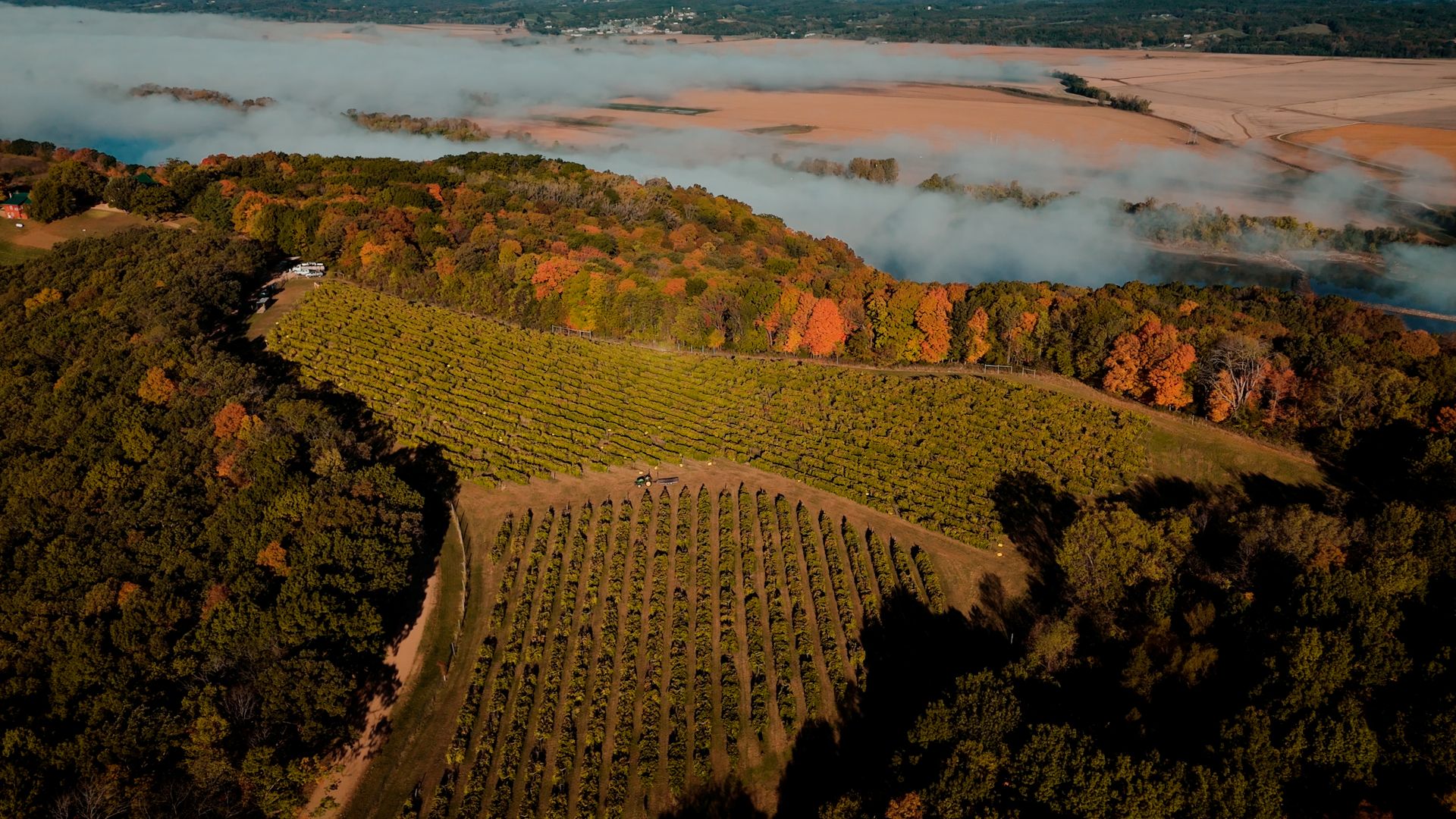
Our vineyards
Winegrowers at heart
High on the bluffs above Hermann, the vineyard is where every Stone Hill wine starts.

Grape growers
We grow what we make
We are not just winemakers. We are grape growers, and sustainably farming our own fruit is central to our commitment to quality. We take what each season gives us and craft something distinct from it.
Missouri grape growing has always demanded that we adapt and experiment. We combine the discoveries of pre-Prohibition Missouri vintners with modern research and decades of our own trials, and have become a leader in managing American heritage and hybrid vineyards.
196
Planted acres
7
Vineyard sites
2
AVAs: Hermann and Ozark Mountain
1983
Hermann named one of the first U.S. AVAs
As Missouri’s largest grape grower, we grow the grapes for our own wines. In 1983 Hermann became one of the nation’s first federally designated American Viticultural Areas, recognized for the qualities that make it a distinct place to grow grapes.

Right plant, right place
Why heritage and hybrid grapes
Our American heritage and hybrid grapes are naturally suited to Missouri’s climate. They are uniquely American, and in the right hands they make excellent wines.
Growing varieties that thrive here is the sustainable choice. Each year we work to bring out the character of every variety, and to find the right style for each grape and blend.
Meet the vineyards
Seven sites around Hermann

Hermann AVA · 900 to 920 ft
Rauch Vineyard
A little more than four miles west of Hermann, above the meeting of the Missouri and Gasconade rivers. The bluff protects against spring frost, and the deep loess soil is Menfro silt loam. Rauch, “smoke” in German, was the name of the farm’s original owners.
Grows: Vignoles, Vidal Blanc, Chardonel, and our Civil War era Norton

Hermann AVA · 900 to 930 ft
Kemperberg Vineyard
Two miles southwest of Hermann, on shallower Marion silt loam that calls for supplemental irrigation. It sits next to the farm where Ed Kemper ran Hermann Grape Nurseries, which supplied most of the area’s pre-Prohibition vineyards.
Grows: Norton and Vidal Blanc

Hermann AVA · 900 to 920 ft
Weingarten Vineyard
Seven and a half miles south of Hermann on shallow Weingarten silt loam. The soil scientist who named the series clearly thought it was made for grapes, and we agree. Weingarten means “wine garden.”
Grows: Chambourcin and Vincent

Ozark Mountain AVA · 950 ft
Morre Vineyard
Our newest and largest vineyard, fourteen miles south of Hermann on a high plateau. Union silt loam gives it good nutrients and drainage, and it is laid out for modern mechanized management. The name honors the original farming family.
Grows: Vignoles, Concord, Traminette, Catawba and Valvin Muscat

Hermann AVA · 900 ft
Rocky Top Vineyard
Six miles south of Hermann near Weingarten, on the same shallow Weingarten silt loam. Our second smallest vineyard is named for the rock outcroppings across the site.
Grows: A little over 4 acres of Chambourcin

Hermann AVA · 880 to 900 ft
Cross J Vineyard
Less than a mile west of Hermann on steep bluffs above the Missouri River, around the home of early Hermann grape growers William and Theodora Poeschel. The drop to the river gives it excellent air drainage, on deep Menfro silt loam. The name comes from Jim Held.
Grows: Norton only

Hermann AVA · At the winery
George’s Vineyard
Our smallest vineyard, right in front of the winery. Before Prohibition, hundreds of acres of vines covered Hermann. This one lets visitors see Norton growing up close, and it is named for George Stark, who led the winery at its pre-Prohibition height.
Grows: Norton

Rauch Vineyard · Planted 1863
The old vines that saved Norton
When Jim and Betty Held reopened Stone Hill in 1965, they went looking for the grape Hermann was built on. They found it at the Rauch farm, where the family had kept a Civil War era vineyard alive and kept making wine through Prohibition. The vines were Norton. Jim pruned and restored them, and that fall Stone Hill made its first Norton since Prohibition.
We still farm that same planting today, and the Old Vine Registry lists it as the second-oldest vineyard in the United States. The old vines bear so little fruit that they fill only a barrel or two in the best years, bottled as our Old Vine Reserve Norton.
1863
Planted
<½
Acre of vines
1 to 2
Barrels in a good year


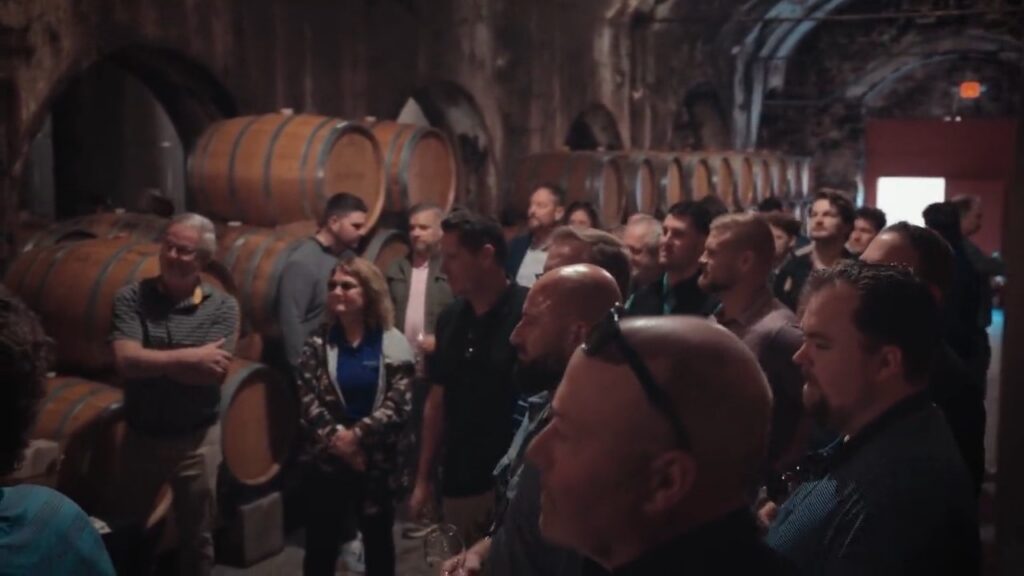
Our cellars
Where the wine rests
Since 1847 our cellars have been central to how we make wine. They stay in the mid-50s year round, a natural, sustainable place to craft and age our wines.
The largest underground cellars in North America, they are a testament to the original German winemakers. Today they pair with modern winemaking to produce the highest quality wines.

Experience it for yourself
From the vineyard to the glass
Our tours take you past George’s Vineyard and down into the cellars, with the story of our winery and how our wine is made.